
Explore AC405 and GC405 graphene PLA/PETG ESD filament for trays, fixtures and housings View source-reported volume resistivity and request grade-specific data
描述
Graphene ESD Filament for Static-Control Part Development
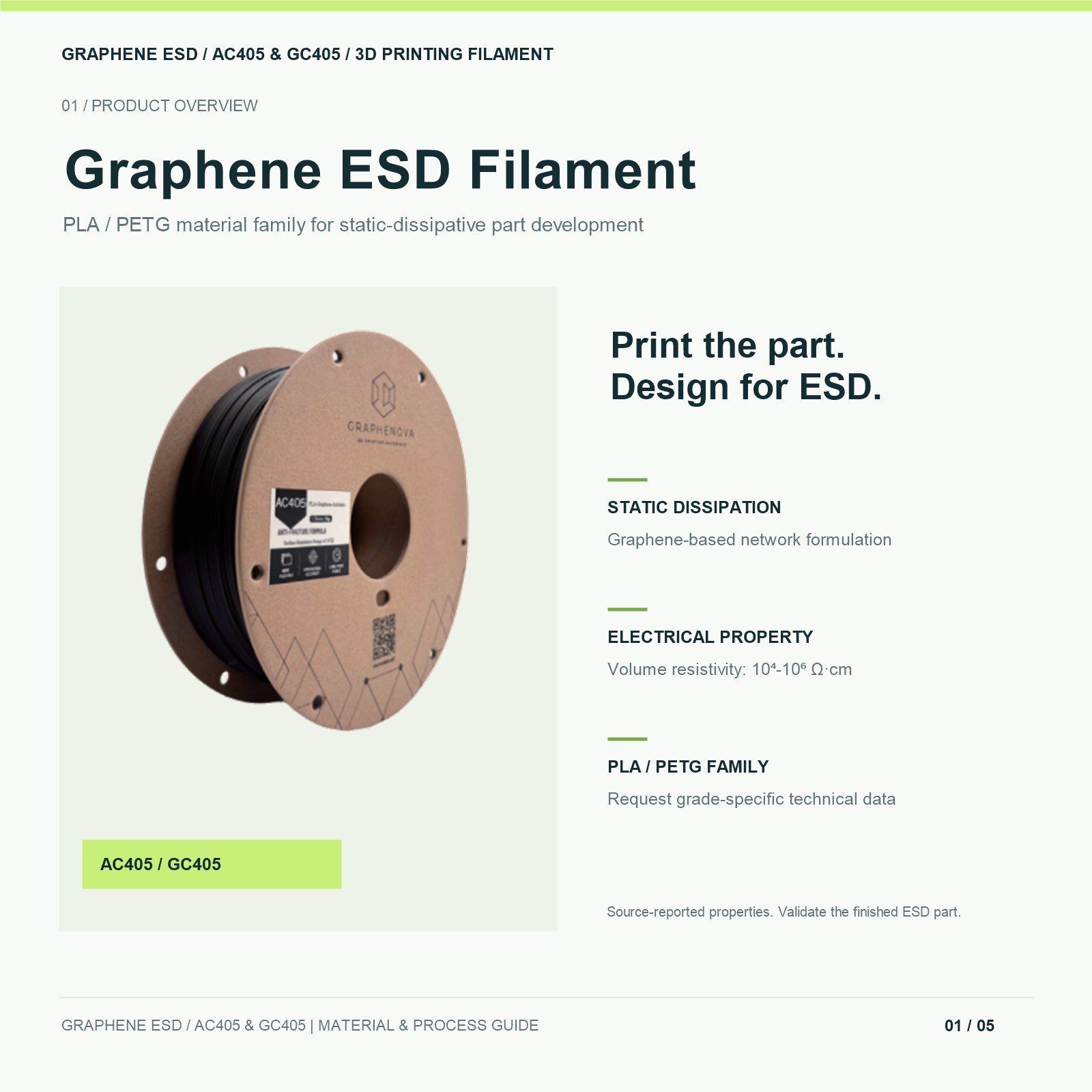
Develop custom static-control parts with the graphene PLA/PETG ESD filament family. The supplied overview identifies AC405 and GC405 as product grades and describes a graphene network formulation designed for static dissipation.
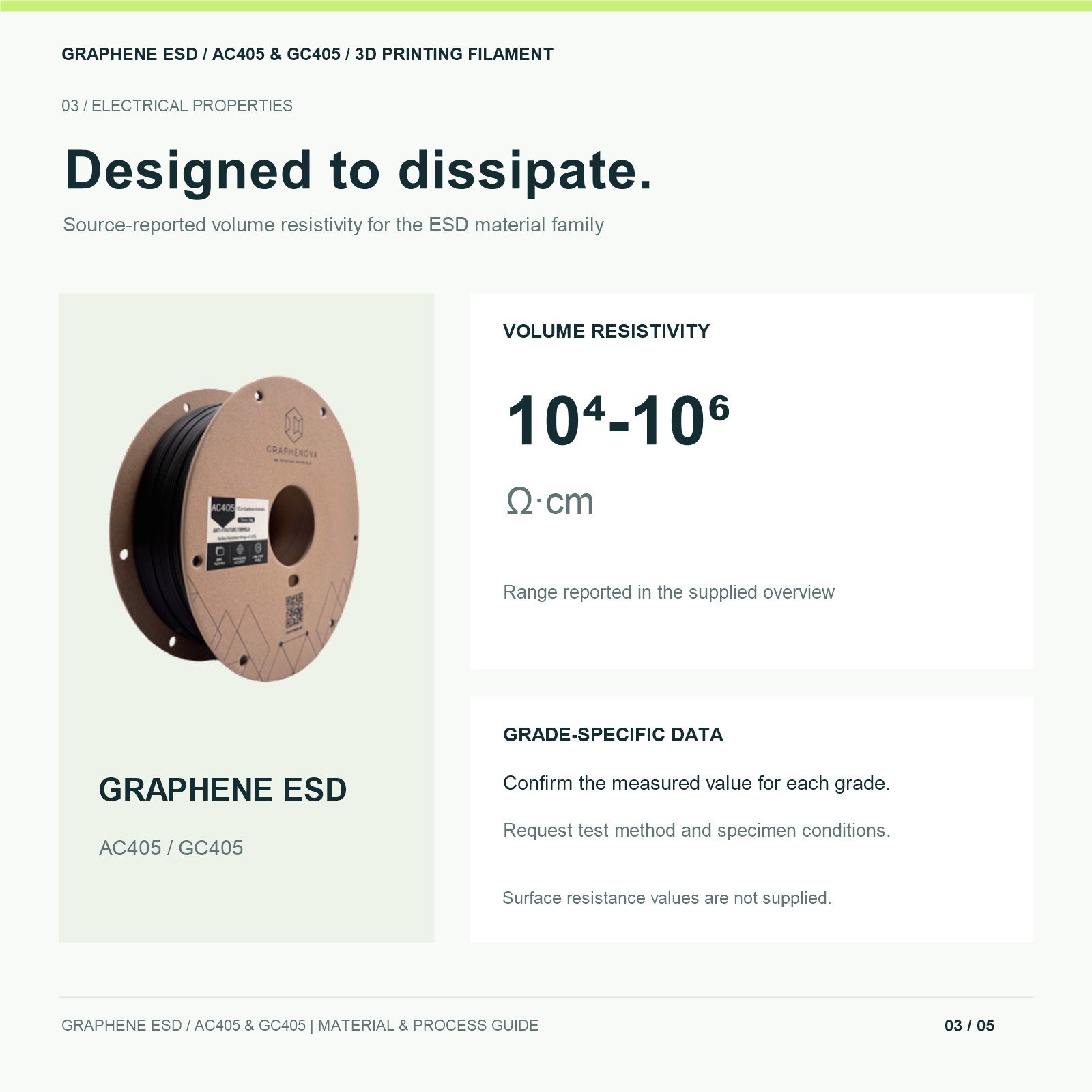
The source reports a volume resistivity range of 10⁴–10⁶ Ω·cm for the material family. Request grade-specific measured values, base polymer identification, test methods and specimen conditions before selecting a grade for a defined ESD requirement.
The overview describes uniform surface resistance, mechanical strength and weather resistance, but supplies no numerical surface-resistance, mechanical or weathering test data. Evaluate these characteristics under the intended use conditions.
Candidate development directions include electronics handling trays and fixtures, wearable-device housings and supports, robotic joint covers, workbench accessories, instrument supports and static-control packaging components. Validate the printed part within the complete handling or protection system.
Key Selling Points
- Static-dissipative formulation: A graphene-based network designed for controlled static-charge dissipation.
- Source-reported resistivity range: Volume resistivity of 10⁴–10⁶ Ω·cm is stated for the material family; confirm values and conditions for each grade.
- PLA/PETG material family: AC405 and GC405 product designations support grade-specific sourcing. Confirm the exact base polymer and processing requirements.
- Custom part geometries: Consider trays, carriers, positioning fixtures, covers and supports for application development.
- Technical sourcing focus: Request electrical, mechanical and process data to qualify the selected grade for your part.
Available Technical Information
| Item | Information from supplied overview |
|---|---|
| Material family | Graphene PLA/PETG ESD 3D printing filament |
| Product designations | AC405 / GC405 |
| Formulation concept | Adjusted graphene network density and conductive-medium ratio |
| Volume resistivity | 10⁴–10⁶ Ω·cm; source-reported family range |
| Grade-specific resistivity values | Not supplied |
| Grade-to-base-polymer mapping | Request explicit supplier confirmation |
| Surface resistance | Described as uniform; numerical value and method not supplied |
| Mechanical strength | Qualitatively described; numerical test data not supplied |
| Weather resistance | Qualitatively described; test conditions and results not supplied |
| Nozzle / bed temperatures | Not supplied |
| Print speed / cooling settings | Not supplied |
| Filament diameter, tolerance and net weight | Not supplied |
| ESD test reports or certification | Not supplied |
Source information has not been independently verified. The family resistivity range is not a guarantee for every printed geometry, direction or environment. The supplied unit Ω·cm describes volume resistivity, not surface resistance or the resistance of a complete part.
Confirm the Print Profile
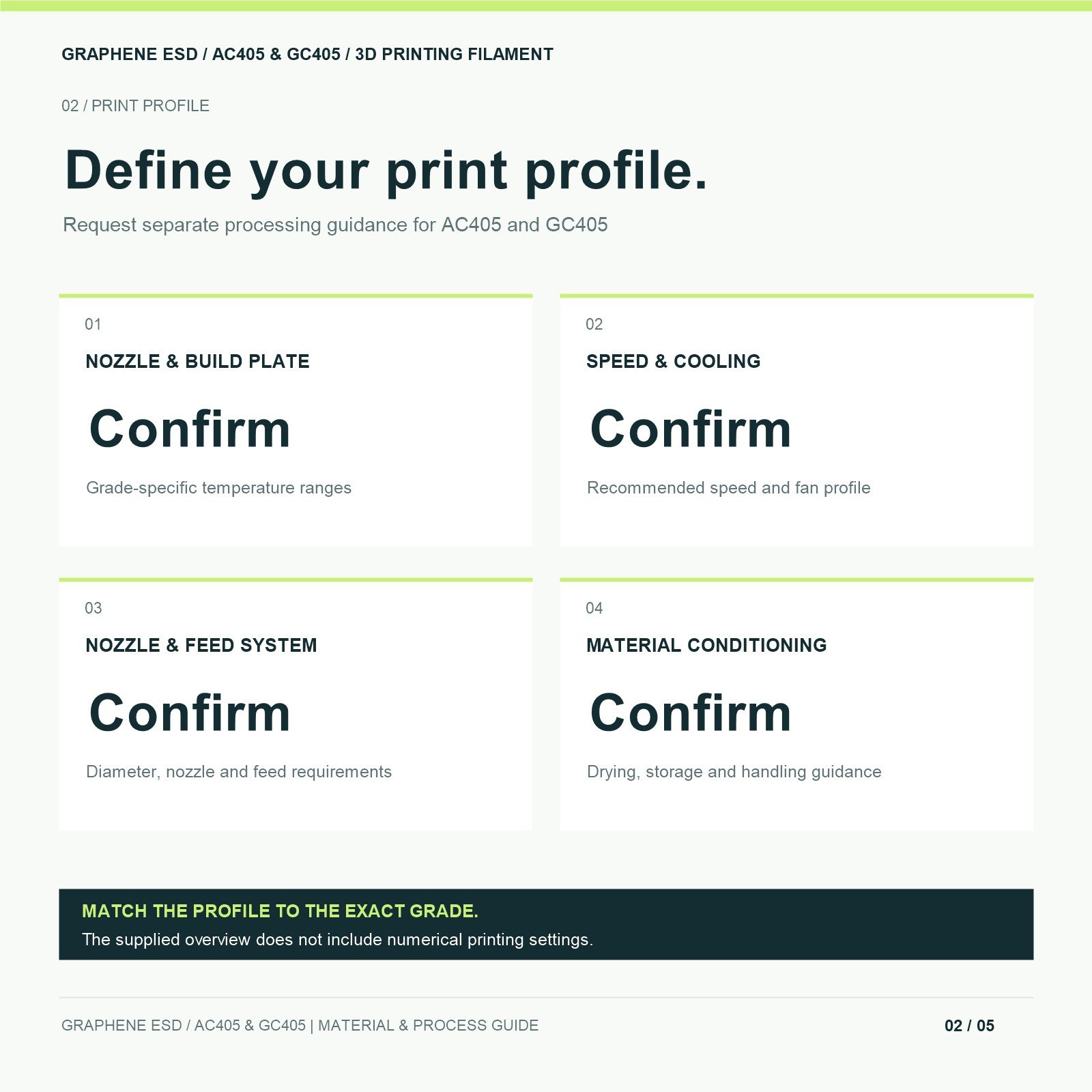
Request the selected grade’s base polymer, nozzle and bed temperatures, print speed, cooling settings, filament diameter, nozzle requirements, drying guidance and storage conditions. Do not assume that PLA- and PETG-based grades use the same print profile.
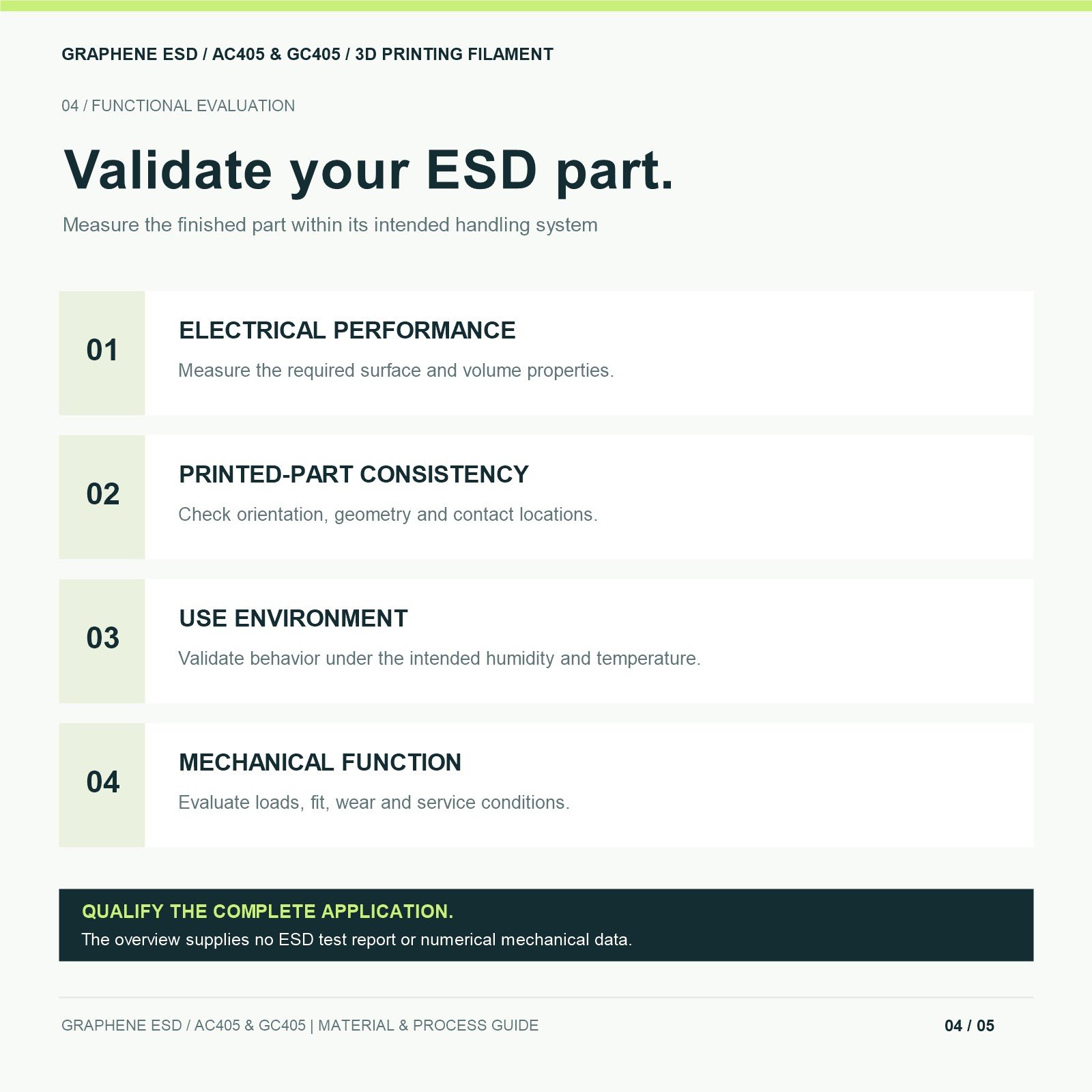
Evaluate the Finished ESD Part
- Measure the electrical properties required by the intended application, including surface and volume behavior where relevant.
- Evaluate printed orientation, geometry, contact locations and consistency across the part.
- Validate performance at the intended temperature and humidity and within the complete handling system.
- Evaluate mechanical loads, fit, wear and service conditions using grade-specific data and part tests.
Potential Applications
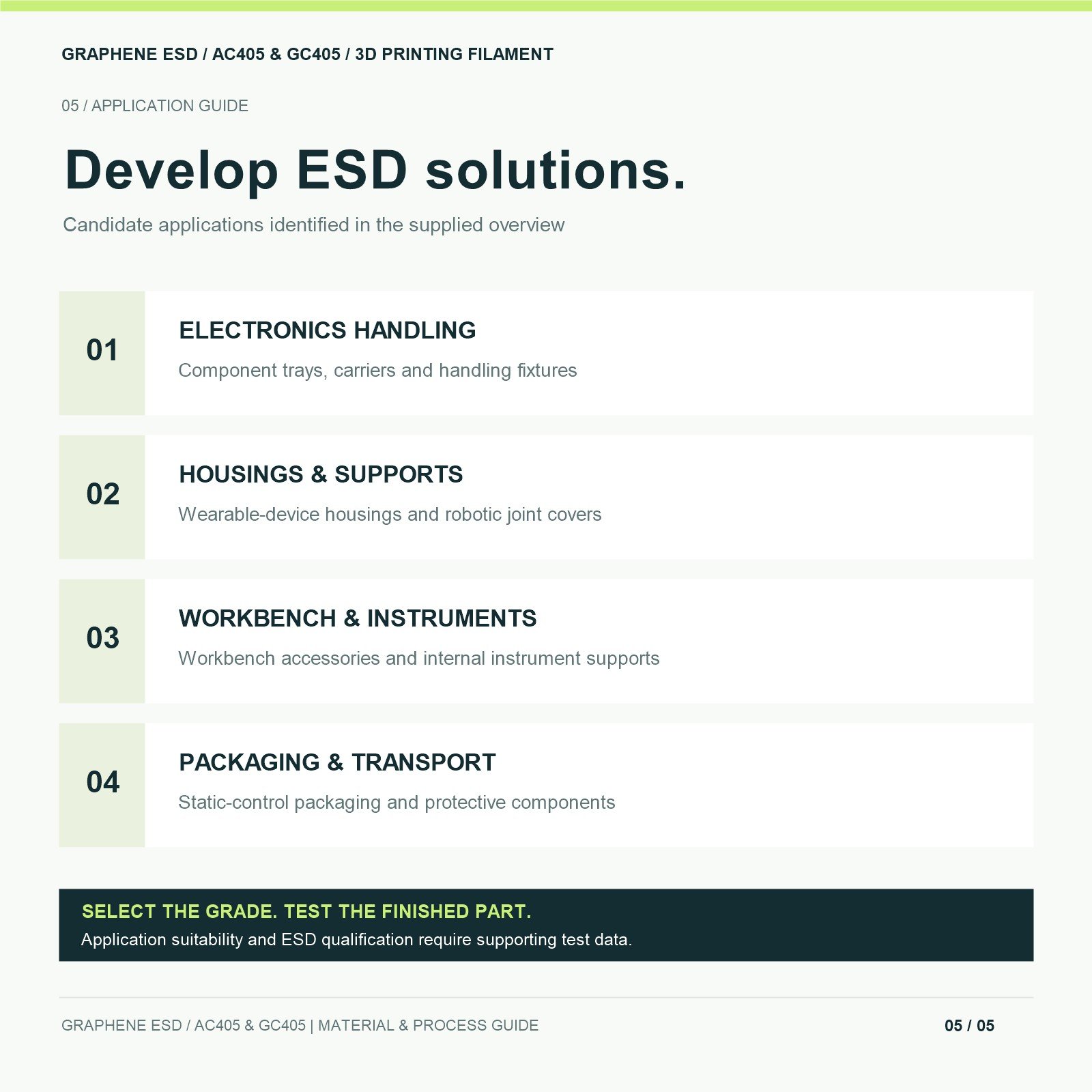
- Electronics handling: Component trays, carriers and handling fixtures.
- Housings and supports: Wearable-device housings, supports and robotic joint covers.
- Workbench and instruments: Static-control workbench accessories and internal instrument supports.
- Packaging and transport: Static-control packaging and protective components.
These are candidate uses described in the overview, not verified application qualifications. Confirm that the finished part and its use conditions meet the applicable electrical and mechanical requirements.
Request Grade-Specific Data & a Quote
Share your target ESD requirements, intended application, preferred base polymer, filament diameter, quantity, printer setup and delivery destination to request a grade-specific specification and quotation.
产品卡片及询价短文案
其他信息
| Graphene-based PLA/PETG filament for static-control trays, fixtures and housings | Print the Part. Design for ESD. Graphene-based PLA/PETG filament for static-control trays, fixtures and housings. Explore AC405 and GC405 graphene ESD filament for custom static-control components. The supplied overview reports a volume resistivity range of 10⁴–10⁶ Ω·cm. Request grade-specific electrical data and printing guidance before material selection. |
|---|


评价
目前还没有评价